
Wing Tsun: Now with Extra Word Salad


If you grew up watching martial arts films like I did, the connection between fighting and philosophy feels as natural as a punch to the nose. Bruce Lee pausing mid-scene to remind us not to mistake the finger for the moon. Mr. Miyagi teaching Daniel that balance on a fishing boat is really balance in life. It all feels so... accepted.
And look, I get it. Most people have heard of Taoism and Buddhism in the context of martial arts so many times that the connection feels ancient, obvious, and unquestionable. Throw in the commonly accepted platitudes; that martial arts make you a more peaceful person, that they teach respect, that a "true martial artist never strikes first"… and you've got a pretty complete mythology built up around the whole thing.
The problem is that most of this mythology is, to put it plainly, a modern invention.
The History Nobody Wants to Talk About
According to scholars like Dr. Peter Lorge and the late Chinese martial arts historian Brian Kennedy, the philosophical packaging we wrap around martial arts today is largely a contemporary construct. Kennedy made a particularly vivid point: if you could travel back in time and ask a Chinese martial artist from a century or more ago whether his fighting system was Buddhist or Taoist, he would probably look at you like you'd lost your mind. Not because he was unphilosophical, but because the question itself would have been completely absurd to him. His fighting techniques were his fighting techniques. Why would his punches belong to a religion?
The muddy connection between Chinese martial arts and Taoist or Buddhist philosophy comes primarily from modern books and pop culture, not from the fighting halls of dynastic China. What's more, the majority of Chinese people throughout recent history blended Confucianism, Taoism, and Buddhism in their daily lives anyway, which means philosophical influences in the martial arts likely came from the individual practitioners, not from the origins of the arts themselves.
Okay, Wing Tsun Does Have Philosophical Roots. Sort Of.
Fair enough, I won't pretend that our art exists in a philosophical vacuum. Wing Tsun does carry genuine fingerprints from all three of China's dominant traditions.
The Confucian influence is probably the most obvious and the most practical. The hierarchical structure of a traditional Wing Tsun school: calling your teacher Sifu, your senior Si-Hing, is straight out of the Confucian family model. It's a governance system, and honestly, it works pretty well for organizing a school, provided it’s not abused and used to control underlings or mystify the Sifu’s skillset.
The Taoist influence shows up in the conceptual framework of the art: yielding rather than clashing, redirecting force rather than absorbing it, outsmarting the opponent rather than overpowering them. Useful ideas, all of them.
And Buddhism? Depending on how far you want to stretch it, you can find it in concepts like the "middle path" as a metaphor for controlling the centerline, or in the mindfulness and detachment that genuinely do support good martial development.
So yes, these threads are there. But here's the thing: the fact that martial arts training and certain philosophies share overlapping ideals does not mean you need to subscribe to those philosophies to be good at fighting. Discipline, focus, and strategic thinking are useful in a fistfight AND in organizing your life AND in running a business. That does not make your quarterly marketing report a Buddhist text.
Where Things Go Off the Rails
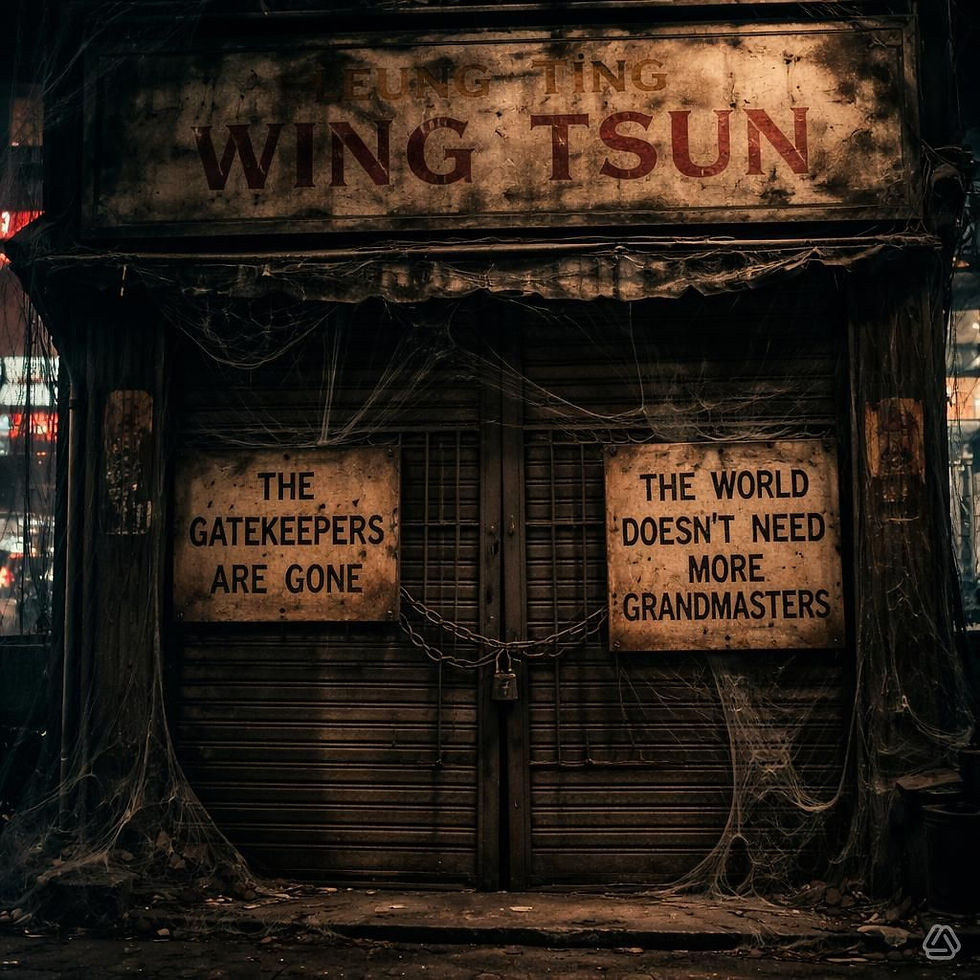
This is where I'll say what needs saying: a significant number of Western Wing Tsun practitioners have developed a habit of drowning perfectly good martial knowledge in philosophical word salad, and it is making our art look ridiculous.
I watch videos regularly where a nuanced and genuinely clever technique like bong sau gets deconstructed through layers of Taoist metaphor and profound-sounding nonsense until the actual mechanical insight is completely buried. The technique stops being a technique and becomes a spiritual experience. When you force everything through a Taoist-colored lens, don't be shocked when everything starts looking Taoist. That's not depth, that's confirmation bias with a good marketing strategy.
This approach suggests that every single aspect of the art must drip with profundity and philosophical justification to be worth teaching or learning. The result is that practical, ingenious knowledge gets stretched and diluted into Eastern wisdom platitudes rather than being conveyed as what it actually is: straightforward, functional, hard-won fighting knowledge.
It also, if we're being honest, reeks of a certain insecurity. It’s as if the art of fighting needs to be dressed up in robes and incense before Westerners will take it seriously. It doesn't. Good martial arts stand on their own.
What Philosophy Actually Belongs in the Gym
None of this means that philosophy has no place in martial arts training. Of course it does.
Dedicated practice builds discipline. Honest sparring tempers the ego. Pursuing mastery over years develops patience, resilience, and genuine self-awareness. Respect for tradition and for your training partners is both taught and earned on the mat. These are real benefits, and they amount to a genuine living philosophy -- a philosophy expressed through how you actually treat people and how you actually conduct yourself in the world.
But here's the crucial distinction: your martial journey can absolutely enhance and inform your living philosophy. The discipline you build in training can make you a more consistent person. The ego-checking that comes from getting tapped out regularly can make you more humble in life. These things genuinely happen.
What should not happen is the reverse. Grabbing a pre-packaged Asian philosophical system off the shelf and using it as the interpretive framework for everything you do in the gym, as if the techniques only make sense once you've understood the Tao. That's the cart leading the horse off a cliff while quoting ancient proverbs about the journey.
Train hard. Learn the techniques. Understand the concepts through honest pressure-testing. Let your character develop as a natural byproduct of that process.
You don't need to co-opt a religion to make fighting more socially palatable. The art is worth more than that, and frankly, so are the philosophies.


Comments